The short answer
For school-age kids we recommend a deck 4 to 6 ft up. That is our choice, not a code rule: it is high enough to feel like a fort and low enough that a 9 in layer of wood mulch protects a fall. Past 30 in the deck needs a guard, past 48 in a climb-proof barrier, and our designer draws decks from 2 ft to 12 ft.
For school-age kids we recommend a deck 4 to 6 ft above the ground. That is our editorial pick, not a number from a code book, and the reasons are practical: the deck is high enough to feel like a real fort, a 9 in layer of wood mulch is deep enough to protect a fall from it, and the posts stay short enough that simple bracing does the job. Everything else in this guide is what changes when you go lower or higher.
Our forts stand on their own posts, so none of this depends on a tree. If you want the full build, see how to build a freestanding treehouse.
What Changes at Each Height
Height is measured from the ground (or the soft surface) up to the deck floor, and three thresholds matter. They come from the CPSC1 home playground handbook (Pub. 324) and from the model residential code.
| Deck height | What you need | What our designer draws |
|---|---|---|
| Up to 30 in | No guard for school-age children. The IRC starts at a drop of more than 30 in, and the CPSC says platforms over 30 in need guardrails or barriers. For under 5s the CPSC public handbook starts a guardrail at 20 in and a barrier above 30 in. | Pick ages 2 to 12 and the designer adds the guard from 20 in. |
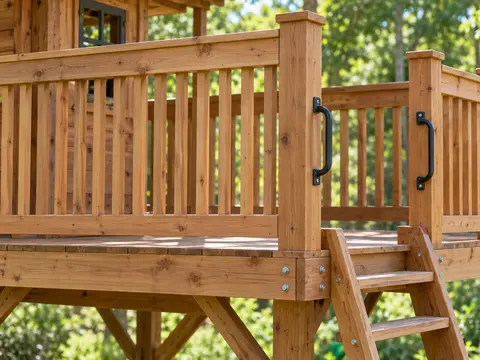
| 30 in to 48 in | A guard around the open sides. The CPSC gives a minimum of 25 in at these heights. | A 38 in guard with infill that no 3.5 in sphere passes. |
| Over 48 in | A barrier, not a guardrail: no gaps of 3.5 in or more, and no crossbars or toeholds a child could climb. | A 38 in barrier from 48 in up, with no rails to climb. |
The 38 in guard is our design choice. It covers both the model code and the CPSC1 at once, so you do not have to work out which one wins. The next guide, treehouse railing height, goes through the guard itself.
Why 48 in is the second line
The IRC measures the 30 in drop anywhere within 36 in of the edge. Once the deck is more than 48 in up, the CPSC1 wants a barrier rather than a guardrail, because a determined child will climb a rail. That means no horizontal rails to step on and no gaps wide enough to trap a head. Gaps of 3-1/2 to 9 in are the dangerous ones, so our designer never draws them.
- 1U.S. Consumer Product Safety Commission Public Playground Safety Handbook, publication 325
- 2U.S. Consumer Product Safety Commission Safety Tips for Home Playground Equipment, publication 324
The Ground Under It Decides the Safe Height
A deck is only as safe as the surface it drops onto. The CPSC1 public playground handbook (Pub. 325, Table 2) lists how much fall height 9 in of compressed loose fill protects against:
| Surface, 9 in deep | Protects against a fall from |
|---|---|
| Wood mulch (non-CCA) | 7 ft |
| Wood chips | 10 ft |
| Pea gravel | 5 ft |
| Sand | 4 ft |
For a home fort the CPSC1 home handbook is a little simpler. It asks for 9 in of mulch, wood chips or rubber mulch up to 8 ft, and sand or pea gravel up to 5 ft. It also says grass and bare dirt do not count, and a fort should never sit over concrete.
Where the two guides differ, the designer takes the stricter figure: wood chips, engineered wood fiber and rubber to 8 ft, wood mulch to 7 ft, pea gravel to 5 ft and sand to 4 ft. Put that next to the height you picked. A 5 or 6 ft deck on mulch sits well inside it. Past 7 ft the designer asks for wood chips, engineered wood fiber or rubber instead, and past 8 ft for a surface whose ASTM F1292 test covers the height.
The surfacing is a required line in every cost number we show, in the total, over the fort and 6 ft around it. Loose fill packs down by about a quarter, so the plan has you put in 12 in to keep 9 in.
- 1U.S. Consumer Product Safety Commission Public Playground Safety Handbook, publication 325
- 2U.S. Consumer Product Safety Commission Safety Tips for Home Playground Equipment, publication 324
Taller Posts Need More Bracing
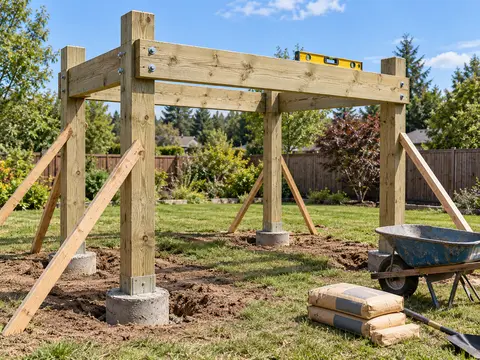
Posts that stand on their own want to rock sideways. The shorter they are, the less that matters.
- Every post: the deck-framing guide DCA6 asks for diagonal braces at each corner post over 2 ft, parallel to the beam, but it leaves the sideways stability of a deck with no house to lean on out of its scope. Our forts stand free, so every post gets knee braces in both directions.
- Sized by calculation: the designer works out the sideways load from the wind speed you enter, using the wind pressures in the IRC tables, or a 200 lb push at the top of the guard, whichever is greater. It then checks the braces, their bolts, the posts and the post bases against the NDS wood design rules and the post base maker’s ratings, and makes the footings heavy enough to hold the fort down.
A taller deck catches more wind on longer posts, so it takes longer braces, more bolts and bigger footings. That is one more reason a lower deck is the easier build.
Our Plans by Height
Each plan is a real design in the planner, drawn from its deck height up. Open one to see the cut list, the materials and the full 3D model.
| Plan | Deck height |
|---|---|
| Low deck for little ones, 6x6 | 2 ft 6 in |
| A-frame fort, 8x8 | 4 ft |
| Open tree fort, 8x8 | 5 ft |
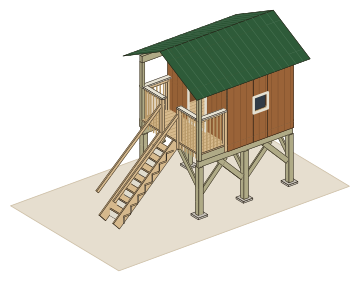
| Half-wall fort with a roof, 8x8 | 5 ft |
| Tree fort with a swing set, 8x8 | 5 ft |
| Open fort with a swing set, 8x8 | 5 ft |
| Playhouse with a swing set, 8x10 | 5 ft |
| Raised playhouse, 8x10 | 6 ft |
| Big fort, 10x12 | 6 ft |
All of them sit inside the designer’s range of 2 ft to 12 ft, and you can change the height in the treehouse designer and watch the guard, the posts and the materials change with it. The swing-set plans keep the swing on a separate frame of its own, never on the fort, because swings should not be attached to composite structures.
Little Ones: Low, Guarded and Easy to Leave
Children from 2 to 5 need more than a lower deck. The CPSC1 public handbook guards their platforms from 20 in, turns the guard into a climb-proof barrier above 30 in, keeps steps to 9 in, and asks for an easier way down than a ladder or a net. The low deck for little ones sits at 2 ft 6 in with a guard for them and easy stairs, and the designer applies the same rules to any fort when you pick ages 2 to 12. A deck that is right for a nine-year-old is too tall for a three-year-old.
- 1U.S. Consumer Product Safety Commission Public Playground Safety Handbook, publication 325
- 2U.S. Consumer Product Safety Commission Safety Tips for Home Playground Equipment, publication 324
Canada: The Guard Starts at 600 mm
The designer has a Canada mode that follows the 2020 National Building Code. Under it, a guard is expected wherever the difference in level is more than 600 mm (about 23.6 in), which is lower than the US 30 in. We apply that rule to a fort as our own choice, since the code does not say how it applies to a play structure. Above a deck 1,800 mm high, the guard goes to 1,070 mm, the code’s general guard height.
Local approval is not checked here. Rules for play structures vary by town and province, so confirm with your local building department before you build.
Picking Your Height
If you are unsure, start at 5 ft. It sits in the middle of our range, works with mulch, and takes a standard guard and simple bracing. Go to 6 ft for a playhouse or a taller child, and drop to 4 ft if the kids are younger or the site slopes. Whatever you pick, open the plan, check the guard and the ground, and ask your building department what applies where you live.
Sources
Every number in this guide that does not come from our own treehouse designer was checked against these 5 documents, numbered in the order the text first cites them and read between Oct 25, 2026 and Oct 26, 2026. 5 are playground guides and codes.
- 1U.S. Consumer Product Safety CommissionPublic Playground Safety Handbook, publication 325
- 2U.S. Consumer Product Safety CommissionSafety Tips for Home Playground Equipment, publication 324
- 3American Wood CouncilPrescriptive Residential Wood Deck Construction Guide (DCA 6, 2015 IRC version) (2015)
- 4City of Seattle2015 Seattle Residential Code (IRC 2015 adoption), chapter 3 (2015)
- 5Simpson Strong-TieCBSTQ cast-in standoff column base, load table (2026)